
Twilight Webinar Recap
Thanks to everyone joining yesterday’s Conifer Twilight Webinar!
For those who couldn’t make it or want to revisit, please have a look at the video recording, the presentation slides, and the summary below.
🌲 If you’re interested in an onlne workshop about self-hosting web archives, please let us know! 🌲
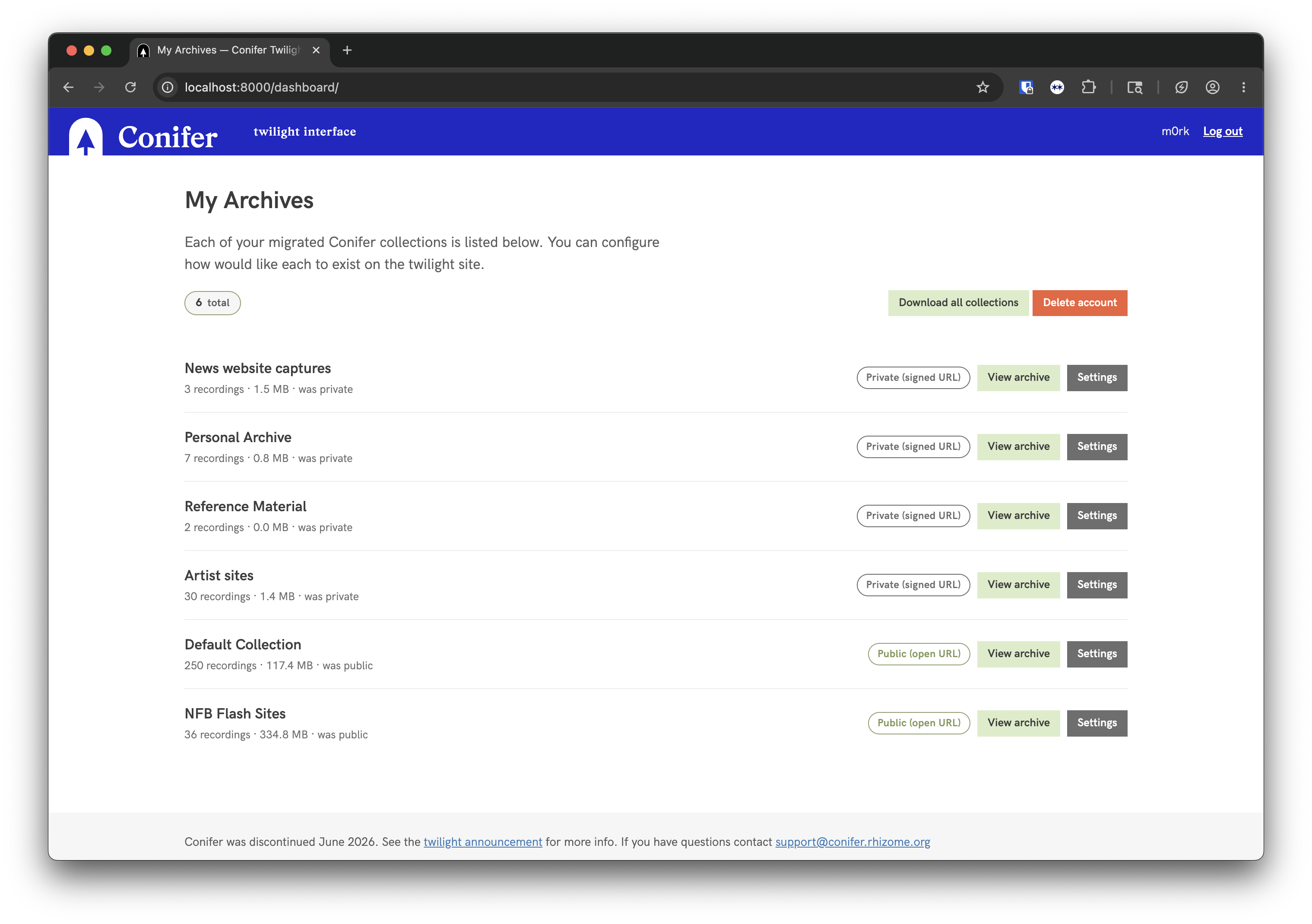
Mark Beasley, former Conifer Lead Developer, demonstrated a beta version of the Tombstone Web App. Its main goal is for users not having to worry about data loss, and allowing high flexibility for migrating data somewhere else. The Tombstone will replace the full Conifer service around mid June 2026. By default, all existing collections will remain accessible withtout any changes to their URLs. Collection access will be provided using Webrecorder’s replayweb.page component. If you just want to keep your collections as-is, you won’t need to do anything, all links pointing to your collections, as well as embeds, will remain intact. Alternatively, you can download your collections in WACZ format to import them into other tools. If desired, a redirect from Conifer to a collection’s new URL can be set up. Deleting collectinos is also possible, which will remove any data or redirects.
Three features Conifer provided will not be available in the Tombstone App due to current limitations of replayweb.page:
- There will be no fulltext search.
- Only a single list of bookmarks will be supported.
- Legacy remote browsers (older versions of Firefox and Chrome) will not be available for access. Flash content will be performed by the ruffle library.
Camille Lawrence, Webrecorder’s Director of Operaions, provided an Introduction to Webrecorder and its goals and projects, which go beyond creating 100% open source components, tools, and services for web archiving. Webrecorder participated in the End of Term Web Archive Initiative, standardized the WACZ portable web archive format, supports activists, and much more.
Tessa Walsh, Webrecorder’s Senior Applications and Tools Engineer, provided information on the WACZ format and how “client-side replay” of web archives works in the Migration and Tools section. In short, WACZ packages ISO standard WARCs, indices, metadata, bookmark lists, etc. in a regular ZIP container. Web archives in WACZ format can be replayed instantly with Webrecorder’s desktop and web tools, as well as open source components that can be used in web pages akin to embedding a YouTube video. If you’d rather want WARC files for integration into classic web archive replay systems based on pywb or the Wayback Machine, it is trivial to extract them, for instance by renaming a WACZ file to include the .zip file extension and using standard unzipping functions of mainstream operating systems. “Client-side replay” means that web archives can be directly accessed with just a browser, without the need for any particular software running on a server. This means that hosting your own public web archive doesn’t require much more than uploading a set of HTML and JavaScript files to a web site together with your WACZ. For folks who want to try this out Webrecorder provides a GitHub repository with a template.
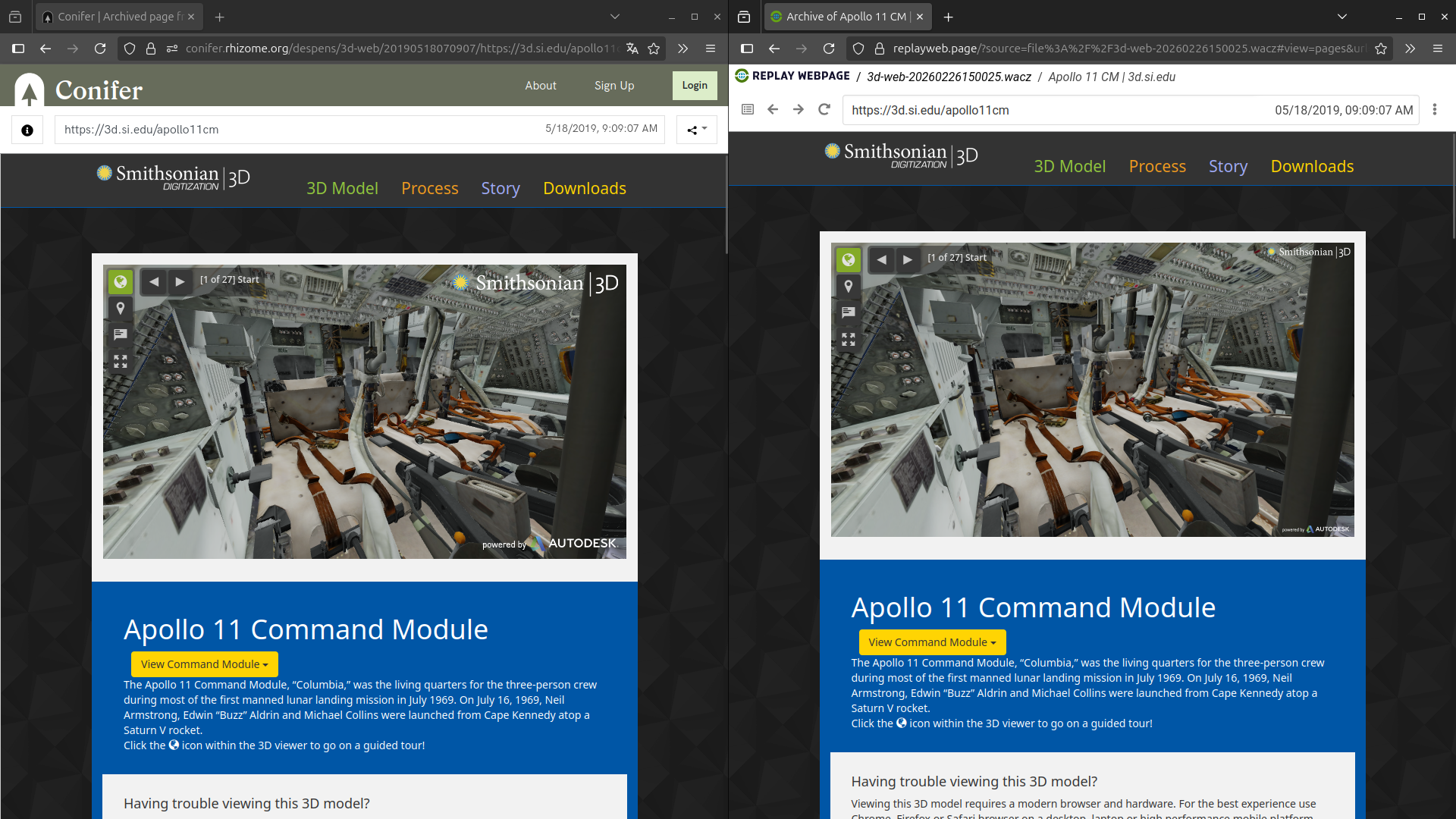
Mona Ulrich, Rhizome’s Web Archivist, demonstrated aspects of Migration Quality by showing three technically complex web archives in Conifer and replayweb.page in comparison. While Conifer is based on pywb, which provides a mix of server- and client-side processing of web archives, the new Tombstone App and most current Webrecorder tools use replayweb.page, which is fully client-side. Just by being moved from one replay system to another, some web archives might behave differently after the migration. Mona surveyed dozens of Rhizome’s own Conifer collections, including ones featuring WebGL 3D graphics, embedded videos, and dynamically loading resources. Judging by this sample, we assume that replay quality will remain identical or improve with the switch to client-side replay. Mona pointed out that no resources will be lost during migration. Any issues that might come up are likely to be fixed with future versions of replayweb.page. Rhizome’s Tombstone App will always load the latest stable version of the replayweb.page component, without requiring any manual updates, as it was previously needed with Conifer.
In the final section about Continuing Web Archiving, Tessa and Camille presented the free and open source desktop application and browser addon archiveweb.page which allows users to manually create and edit web archive with a user interface very similar to Conifer’s. Browsertrix is Webrecorder’s for-pay hosted service providing sophisticated automation, browser profile management (log in to web sites before automatically capturing them!), and public collections. Conifer users can use a coupon for a 10% reduction for the first 12 months of subscription, watch the video to learn the secret combination of letters and numbers 😉. Browsertrix is fully open source software and can be self-hosted as well.
We hope that we were able to answer all questions of Conifer users and provide satisfying options for your future web archiving endeavors. If you have any more open questions or comments, don’t hesitate to contact support@conifer.rhizome.org.